

INDUSTRIAL AUTOMATION & ROBOTICS INSIGHTS
The Industry 4.0 section of FactoryUniC delivers a curated collection of practical PDF and PPT tools designed to help leaders explore, and implement, the most powerful Industry 4.0 technologies in industrial operations. You'll find real-world use cases around collaborative robotics, mobile robots, and artificial intelligence to help smart manufacturing become more than just a buzzword. These resources go straight to what matters, showing when and how to apply advanced technologies effectively on the factory floor.
Robotics
Key uses of a industrial robot

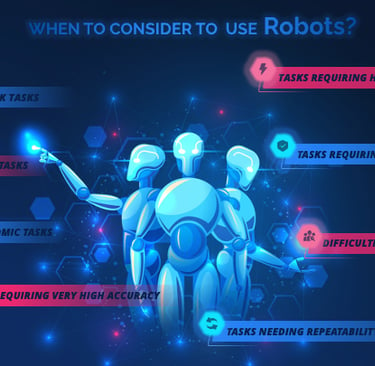
ROBOTICS IN MODERN INDUSTRY: WHEN TO CONSIDER TO USE A ROBOT
In the ever-evolving landscape of modern industry, the integration of robotics has become more critical than ever. Robots can significantly enhance efficiency, safety, and productivity in various sectors. Here’s an in-depth look at the key scenarios where robotics can be most beneficial:
1.- High-Risk Tasks
Tasks that pose significant safety risks to workers.
Example: Handling hazardous materials or operating in extreme environments.
2.- Health or Safety Hazard tasks.
Tasks that expose workers to harmful conditions or substances.
Example: Working in environments with toxic fumes, dust, heat, chemicals, radiation, noise, cold rooms, etc.
3.- Non-Ergonomic tasks.
Tasks that involve repetitive motions or awkward postures, leading to strain and discomfort.
Example: Manual pallet handling, repetitive assembly, loading/unloading machines, awkward picking operations, etc.
4.- High-Precision tasks.
Tasks that demand precise and consistent accuracy that is difficult to maintain manually over many hours.
Example: Precision positioning, electronic assembly, dosing, inspection, welding, etc.
5.- High-Speed Repetitive tasks.
Tasks that need to be completed quickly and efficiently.
Example: Packaging, sorting, palletizing, machine feeding, material transport, high-frequency pick-and-place operations, etc.
6.- Quality-Critical Tasks.
Tasks where maintaining consistent quality is crucial.
Example: Welding process in the automotive industry, gluing, dispensing, inspection, screwdriving, etc.
7.- Labor shortages or high turnover scenarios.
Situations where finding skilled manpower is challenging or hast high turnover rates.
Example: Warehouses, night shifts, factories in remote locations, etc.
The integration of robotics into industrial operations is no longer a futuristic concept but a present-day necessity. Robots are not just tools; they are partners in driving industrial innovation and excellence.
Is your process ready for robot automation? Let’s talk: contact@factoryunic.com