

HEALTH & SAFETY
Responsible Suppliers. Safer Working Conditions. Lower Business Risk.
Selecting the right supplier is not only about price, quality and delivery. It is also about ensuring that employees are treated responsibly and that manufacturing activities are carried out under safe and appropriate working conditions.
FactoryUniC assess visible evidence that suppliers are following applicable occupational health and safety regulations and the specific requirements agreed with our clients. When potential risks or gaps are identified, we report them clearly and can coordinate corrective actions and follow-up directly with the supplier.
This helps our clients reduce operational, legal, supply-chain and reputational risks when sourcing or manufacturing in China.
Explore Our Health & Safety Topics
Below, we share a selection of practical occupational health and safety topics covering common industrial risks, preventive measures and good practices that can help create safer, healthier and more responsible working environments.
H&S department
Department's Key Roles
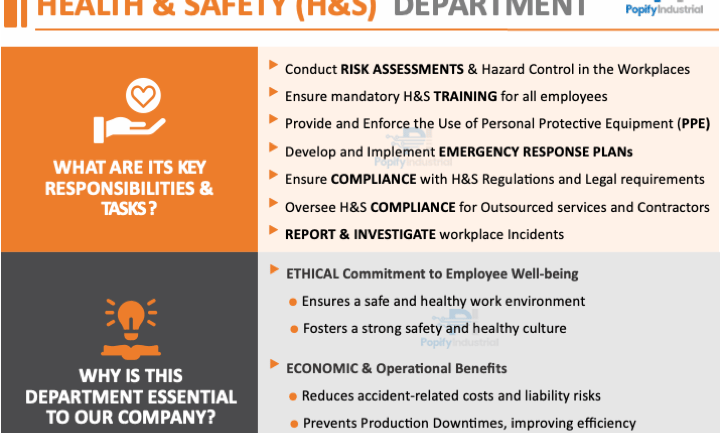

HEALTH & SAFETY | THE ROLE AND IMPORTANCE OF THE H&S DEPT.
Ensuring employee well-being and workplace safety is crucial for any organization. The H&S Department plays a key role in reducing risks, enforcing safety standards, and fostering a responsible work culture.
Key Responsibilities & Tasks
1.- Conduct Comprehesive Risk Assessments & Hazard Control.
Identify workplace potential risks (physical, chemical, ergonomic, psychosocial, etc.) and implement preventive measures to eliminate hazards that may cause injuries or long-term health issues. 💡 Talk to the workers — they’re the ones who know the real risks better than anyone.
Regularly review and update risk control procedures...
We will publish this new document in the coming weeks.
H&S department
Hazards in a Workshop - CheckList
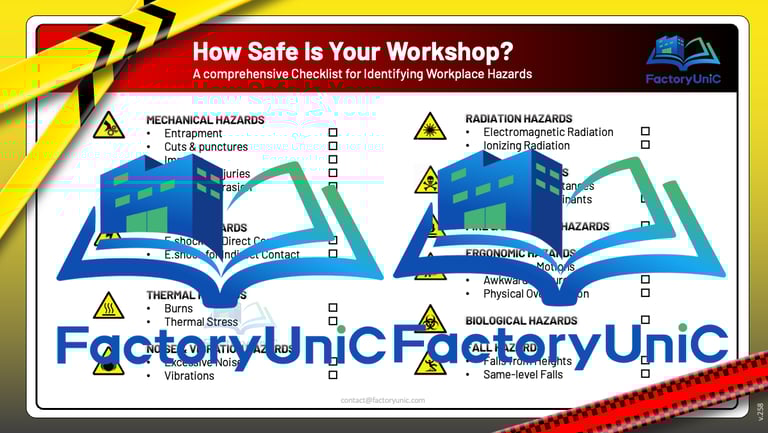

HEALTH & SAFETY | IDENTIFYING KEY HAZARDS IN A WORKSHOP
Ensuring safety in a workshop is not just about following rules—it's about creating a culture that prioritizes the well-being of everyone involved. In environments filled with heavy machinery, electrical equipment, and hazardous materials, it's vital to be proactive in identifying potential risks. Here are the top hazards to be aware of in any workshop setting:
🔧 Mechanical Hazards
Entrapment: Risk of body parts or clothing being caught in moving machinery or equipment
Cuts and punctures: Potential for injuries due to sharp edges, tools, or equipment.
Impact from falling objects: Dangers associated with objects falling from height...
We will publish this new document in the coming weeks.
H&S department
PPE - Safety Shoes Use
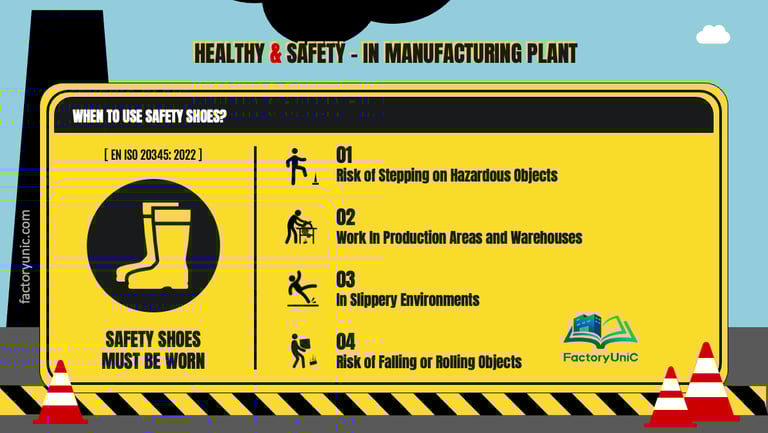

HEALTH & SAFETY – MANUFACTURING PLANT - WHEN TO USE SAFETY SHOES?
It is fundamental to ensure the protection of all employees in the factory through the proper use of personal protective equipment (PPE). Safety shoes must always be worn in the following situations:
Risk of Stepping on Hazardous Objects. nails, sharp scrap, swarf, metal debris, or other pointed items that could penetrate normal footwear.
→ Required feature: Anti-puncture midsole.
Work in Production, Warehouse, and Loading Areas. Safety shoes must be worn at all times in these zones, regardless of specific tasks, due to constant movement of materials and equipment.
→ Required feature: Heat-resistant safety footwear (S2/S3 level or...
We will publish this new document in the coming weeks.